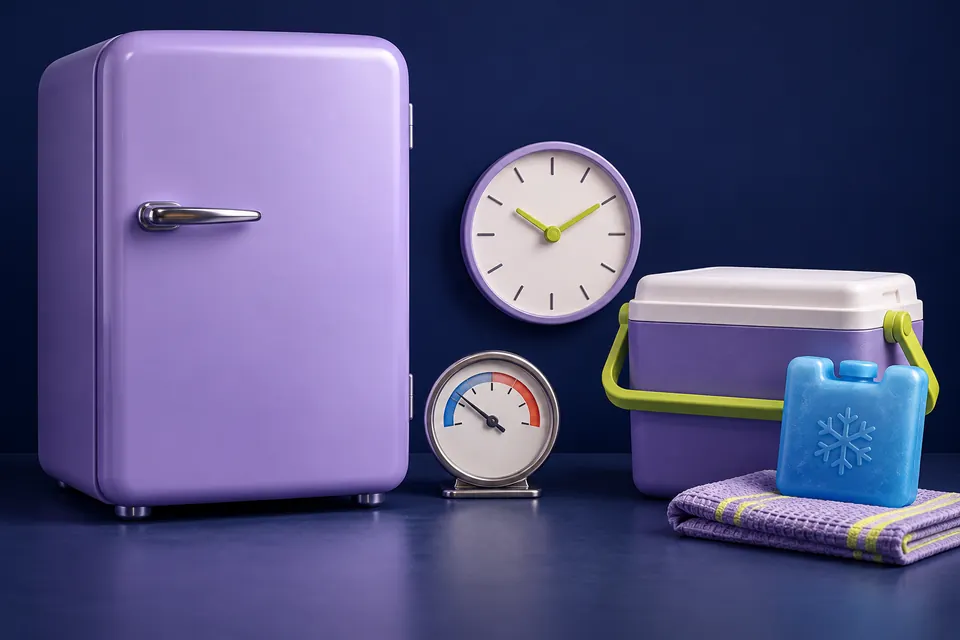
The first checks, in pictures
Start with these three checks. The pictures are simplified; the steps below explain the details.
Keep the door closed
Record when power failed. Avoid repeated checks inside.
See this step — Keep the door closedUse time and temperature
A thermometer and the food-specific guidance matter more than smell.
See this step — Use time and temperatureCheck each food type
Follow the safety chart. Never taste food to decide whether it is safe.
See this step — Check each food type
The power goes out and the first question is whether the food will still be safe. Opening the fridge repeatedly to check how cold it feels works against you. Start by recording the outage time and keeping the doors closed. Then use official time-and-temperature guidance for the food you actually have. This guide helps you organise those decisions without pretending that a smell test or a phone timer can certify a meal. It covers an ordinary loss of refrigeration. Flood contamination, damaged appliances and instructions from emergency authorities require their own response and take priority over a kitchen checklist.
The first useful check
Keep fridge and freezer doors closed, note when power failed and use appliance temperatures and official food-specific guidance. Perishable refrigerated food generally needs discarding after four hours without power unless safe cold storage has been maintained. Never taste food to judge safety.
Which situation sounds like yours?
Power has just failed
Keep doors closed and record the time.
A long outage is expected
Arrange safe cold storage if feasible and follow authority guidance.
Power returns and food history is known
Use the official food-specific chart and measured conditions.
Time or temperature history is uncertain
Do not use taste or smell as proof of safety.
Step 01
Write down the time before memory becomes uncertain
Note when the power stopped, or the earliest time you know it was off. If you arrived home to a dark house and do not know when the outage began, write 'unknown' instead of inventing a start time. An appliance thermometer can provide useful current information, but a cold reading after power returns does not reconstruct everything that happened earlier.
Keep one shared note for the household: outage start, any transfer to a cooler, observed temperatures and power restoration. This avoids one person assuming that another checked the food. Put the note somewhere accessible without opening the fridge. Do not repeatedly open the door to add detail to the record; preserving the cold environment is more useful than frequent visual inspections.
Step 02
Understand what the four-hour rule refers to
FDA guidance says an unopened refrigerator keeps food cold for about four hours. FoodSafety.gov advises discarding refrigerated perishables such as meat, fish, eggs and leftovers after four hours without power. These are general emergency rules, not a promise that every fridge, room temperature or door-opening pattern behaves identically. If you have maintained safe cold storage with an appropriate cooler and ice, evaluate the actual conditions using official guidance.
Do not confuse the approximate outage window with the separate time a particular food has spent above its safe temperature. FoodSafety.gov's food-by-food chart uses exposure to 40°F (4°C) or above for more than two hours for many perishables, with specific exceptions. Use the current chart for the actual item. A single broad slogan cannot replace its distinctions.
Step 03
Plan a cold-storage alternative before it is urgent
If a prolonged outage is likely, identify a suitable cooler and ice or frozen packs while you can do so safely. FDA guidance recommends preparing these options in advance. Move food only when you can keep it appropriately cold; transferring it to an uncooled bag does not solve the problem. Use a thermometer and keep raw foods contained to avoid contaminating other items.
Choose a simple household role: one person tracks times and one manages the practical transfer if help is available. Record when food moved and the relevant temperature observations. Do not drive through unsafe conditions or ignore evacuation instructions to save groceries. The purpose of planning is to reduce hurried decisions, not to turn food preservation into a more serious risk.
Step 04
Assess freezer contents separately
A closed full freezer and a half-full freezer retain cold differently. FDA and FoodSafety.gov describe approximate holding periods of 48 hours for a full freezer and 24 hours for a half-full one when the door remains closed. Treat these as planning guidance, not automatic clearance for every item. Conditions and the actual state of the food still matter.
FoodSafety.gov explains that many frozen foods can be refrozen if they still contain ice crystals or remain at 40°F (4°C) or below, but its chart includes exceptions such as ice cream. Follow the relevant row rather than applying one rule to everything. Quality may change even when refreezing is permitted. Keep freezer observations separate from the refrigerator record so the two timeframes do not get mixed up.
Step 05
Use a food-by-food decision, not a smell test
Open the official chart linked below and identify the food category accurately. A hard cheese, a soft cheese and a prepared dish containing dairy may not share the same recommendation. If you cannot establish the temperature history or appropriate category, seek reliable food-safety advice or discard the uncertain perishable item. Do not taste it as an experiment; harmful contamination may not provide an obvious warning.
Make a short list of discarded items if you need it for household records, but do not keep unsafe food while deciding whether to photograph every package. A phone photo of the label taken during the decision is enough for ordinary personal notes. Keep the process clear for other household members so that food already marked for disposal is not accidentally returned to use.
Step 06
Prepare for next time with a small kit
Once the immediate situation is resolved, check that you have an appliance thermometer, an accessible cooler if useful and a place to record outage times. A simple paper sheet is often more dependable than an online tool when the connection or battery is limited. Store the official guidance somewhere you can reach during an outage, without relying on a bookmarked page loading at that moment.
Review what made the decision difficult. Was the start time unknown? Did nobody know where the cooler was? Were freezer contents unlabelled? Fix one practical gap. The useful low-cost improvement is often organisation and measurement, rather than a new appliance. This guide deliberately does not provide an automatic 'safe to eat' calculator: the missing facts and food-specific exceptions are too important to hide behind a green result.
An example you can follow
A cold reading after power returns is incomplete evidence
Illustrative example: Taylor returns home after an unknown-length outage. The power is now on and the fridge is cooling again. The current temperature alone cannot show how warm perishable food became earlier. Taylor records that uncertainty and follows official disposal guidance rather than assuming that a now-cold container was continuously safe. Afterwards, the household puts an appliance thermometer in place and agrees to record future outage times. The lesson is about evidence: a later good reading does not erase an unknown period.
Outage evidence record
Write unknown where information is missing. This record supports an official food-specific decision; it does not certify food safety.
| Event | Time | Evidence |
|---|---|---|
| Power failed | Known time or unknown | How the time was established |
| Food moved to safe cold storage | Time or not moved | Cooler and temperature observations |
| Power restored | Observed time | Do not infer earlier temperatures |
| Item assessed | Decision time | Official chart category used |
Questions you might still have
Can I smell or taste food to check it?
No. Official guidance says not to taste food to determine safety. Appearance and smell cannot establish a safe temperature history.
Is everything in the fridge treated the same?
No. Use the food-by-food chart. Perishable prepared foods, hard cheeses and condiments can have different guidance.
Can this page tell me whether a particular meal is safe?
It helps organise the facts, but it cannot inspect your food or reconstruct missing temperatures. Use official guidance for the exact item and do not guess when key facts are unknown.
Sources & how this guide was made
Written by LoschaZ from the guidance below. The illustration is our own. Worked scenarios are labelled as illustrations; they are not customer stories or tests on every device. For product-specific steps, follow the current instructions for your device, account or item.