
Car & driving · Free
P0300: random or multiple cylinder misfire
P0300 means the engine computer counts misfires that it cannot pin to one cylinder, or that move between several. Worn spark plugs and ignition coils cause most of them, but a lean mixture or a mechanical fault can too. A flashing check engine light means: slow down now.
- No account
- Runs on your device
- Phone & desktop
Check your car for P0300
Runs on your device
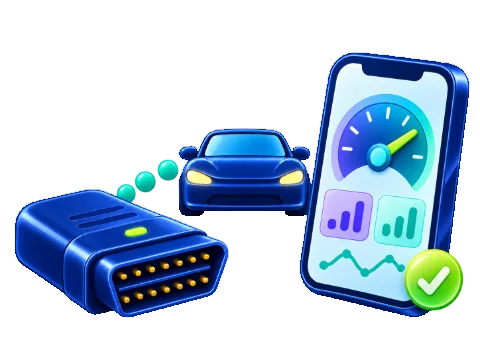
Connect your OBD2 adapter
- Plug the adapter into the OBD2 port – usually under the steering wheel, near the pedals.
- Switch the ignition on, or start the engine.
- Bluetooth adapter? Turn Bluetooth on. Nothing else to set up.
This browser cannot talk to OBD adapters. Use Chrome or Edge on Android, Windows or Mac – on iPhone, the free Bluefy browser works with Bluetooth LE adapters. The demo car works everywhere.
Classic Bluetooth adapter (PIN 1234)? Pair it in your system settings first, then choose USB or paired Bluetooth – on a computer or in Chrome 138+ on Android. Wi-Fi adapters cannot work in a browser.
Your car data stays on your device. The page talks to the adapter directly; codes, VIN and values are never uploaded.
Never use it while you drive. Set things up before you set off, or let a passenger handle the phone. Standard OBD2 reads engine and emissions data; ABS, airbag and coding need workshop equipment.
What P0300 means
Every time a cylinder fires, it gives the crankshaft a small push. The engine computer watches the crankshaft speed through its sensor, and when a push is missing, it counts a misfire. If the misfires stay in one cylinder, you get a code with its number: P0301 for cylinder 1, P0304 for cylinder 4. If they jump around or hit several cylinders, you get P0300.
A random misfire points toward something all cylinders share: the fuel supply, the mixture, spark plugs that wore out together or the mechanical condition of the engine. Unburnt fuel goes straight into the catalytic converter and overheats it, which is why heavy misfiring makes the check engine light flash.
Symptoms of P0300
- The engine shakes or runs unevenly, most noticeably at idle.
- Jerking or loss of power when you accelerate, especially uphill or with a load.
- A flashing check engine light during heavy misfires.
- A smell of fuel from the exhaust and higher fuel consumption.
- Harder starting, particularly in damp or cold weather.
Causes of P0300, cheapest first
Work down the list in order: the first checks cost little or nothing, the last ones are jobs for a workshop.
Worn spark plugs
Plugs past their service interval need more voltage to spark, and misfires start under load. Check the service history; a full set of plugs is cheap on most four-cylinder engines.
Ignition coils or plug leads
A weak coil usually hits one cylinder, but several tired coils or cracked leads can produce P0300. Swap a suspect coil with its neighbour: if the misfire moves with it, the coil is faulty.
A lean mixture or vacuum leak
With too much air, the mix burns poorly in every cylinder. If P0171 or P0174 is stored as well, fix the lean condition first.
Fuel problems
Low fuel pressure, a clogged filter, water in the fuel or dirty injectors can starve several cylinders at once.
Engine mechanics
Low compression from worn rings or valves, a timing belt or chain that has slipped, or a leaking head gasket. A compression test tells you whether the engine itself is healthy.
Can you drive with P0300?
Flashing light: avoid driving. If the check engine light flashes, reduce speed and load at once and drive only as far as you must: unburnt fuel can overheat and ruin the catalytic converter within a short time. With a steady light and only slight roughness, drive gently and have the misfires found soon.
Check P0300 with OBD Studio
Connect your adapter above, or try the demo car, then:
- Open Fault codes: the freeze frame shows engine speed, load and coolant temperature when the misfires were stored. Misfires only at cold start point to other causes than misfires at full load.
- In Inspection, tap Read self-tests (cars with CAN): Misfires per cylinder shows how often each cylinder misfired on the current drive, which often reveals the worst one.
- In Live data, check the fuel trims. High positive values mean the mixture is lean.
- After the repair, clear the codes and make sure the misfire counts stay at zero on a test drive.
More fault code guides
Each of these codes has its own page with causes ranked by cost and the checks that go with them.
- P0420Catalyst efficiency below threshold
- P0171System too lean
- P0455EVAP system large leak
- P0442EVAP system small leak
- P0128Engine warms up too slowly
- P0172System too rich
- P0401EGR flow too low
- P0101Air flow sensor implausible
- P0135Front O2 sensor heater
- P0016Crankshaft and camshaft out of step
- P0011Intake camshaft timing over-advanced
- P0141Rear O2 sensor heater
- P0113Intake air temperature sensor high
- P0457Fuel cap loose or missing
- P0299Turbo underboost
- P0700Transmission control system fault
- P0087Fuel rail pressure too low
- P0562System voltage low
- U0100Lost communication with engine computer
More OBD Studio pages
Frequently asked questions
Can I drive with P0300?
With a steady light and an engine that runs smoothly most of the time, short careful trips are possible. With a flashing light, stop driving as soon as it is safe: heavy misfires can damage the catalytic converter quickly.
How do I find which cylinder is misfiring?
Read the misfire counts per cylinder in the Inspection tab, if your car reports them. You can also swap ignition coils between cylinders and see whether the misfires move.
Can bad fuel cause P0300?
Yes. Fuel with water or dirt in it can make all cylinders misfire. If the problem started right after filling up, use up the tank gently and refill with fresh fuel from another station.
Can I read P0300 without going to a workshop?
Yes. With any ELM327-compatible Bluetooth LE or USB adapter, OBD Studio on this page reads P0300 and every other stored code for free, shows the freeze frame and clears the code after the repair. Nothing to install, no account.

