The short answer
Most guides use seven face shapes: oval, round, square, heart, diamond, oblong (long) and triangle (pear). Measure your forehead, cheekbones and jaw across and your face from hairline to chin. Then find the widest part and compare length with width. Many faces sit between two shapes, and that is normal.
Open the free toolTypes of face shapes: the seven that most guides use
Most stylists and opticians use seven face shapes: oval, round, square, heart, diamond, oblong and triangle. Each name says two things: which part of the face is widest, and how long the face is compared with its width. Some lists use five shapes or add an inverted triangle, but they describe the same outlines.
Think of the shapes as words, not boxes. Nobody matches a drawing exactly. The names help because once you know where your face is widest, it is easier to pick a haircut, a beard or glasses that balance it.

| Face shape | What you usually see | Widest part |
|---|---|---|
| Oval | About one and a half times as long as wide; forehead a little wider than the chin; soft jaw | Cheekbones |
| Round | Length and width about equal; full cheeks; soft jaw; rounded chin | Cheekbones |
| Square | Length and width about equal; straight sides; clear jaw corners | Equal from top to bottom |
| Heart | Wide forehead, narrower jaw, slim or pointed chin | Forehead |
| Diamond | Narrow forehead and chin; high, wide cheekbones | Cheekbones |
| Oblong (long, rectangle) | Clearly longer than wide; straight sides; similar widths | Equal, but long |
| Triangle (pear) | Jaw wider than the forehead; strong jawline | Jaw |
How to determine face shape with a tape measure or a mirror
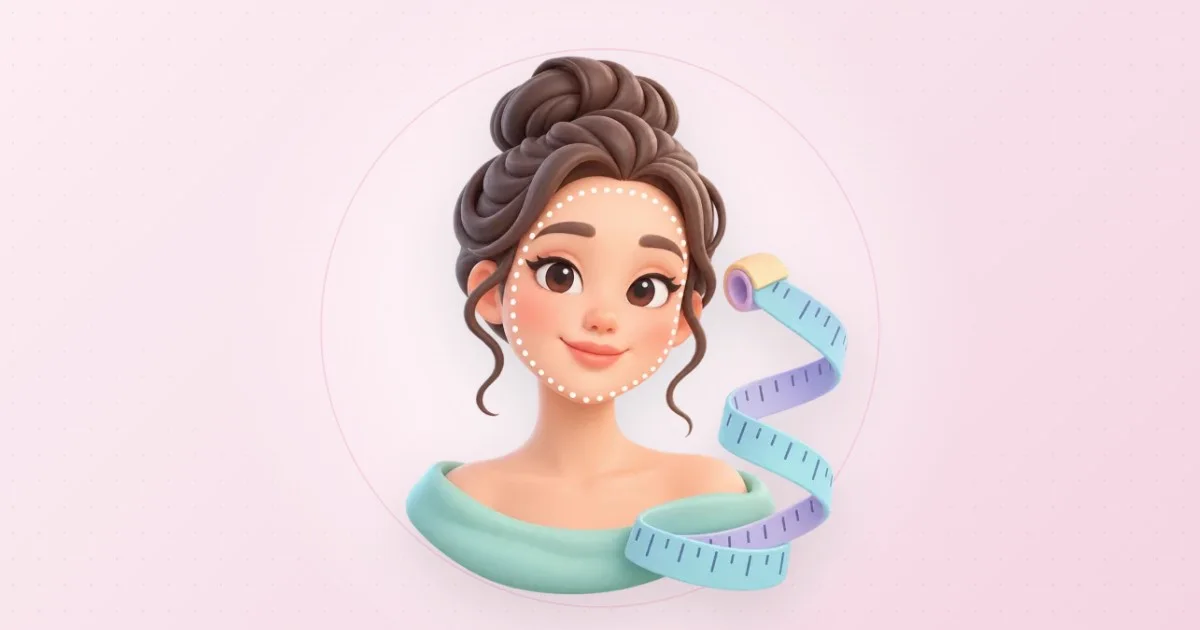
To determine your face shape, take four measurements with a soft tape measure: forehead, cheekbones, jawline and face length. Pull your hair back, take off your glasses and keep a relaxed face. Hold the tape straight across the face, just off the skin, instead of pressing it around the curve.

Forehead
Measure across the widest part of the forehead, from hairline to hairline, usually halfway between the eyebrows and the hairline.
Cheekbones
Measure between the highest points of the cheekbones, just below the outer corners of the eyes.
Jawline
Measure straight across from one jaw corner, below the ear, to the other.
Face length
Measure from the middle of the hairline down to the tip of the chin. With a receding hairline, measure from where it used to be; this number is the least certain one.
How to read your face measurements
Start with the widest of the three widths, then compare it with the length. Length about one and a half times the cheekbone width suggests oval; clearly longer with similar widths suggests oblong. Length close to the width points to round with a soft jaw, or square with an angular one. Widest at the forehead with a slim chin is heart, widest at the cheekbones with a narrow forehead and chin is diamond, and widest at the jaw is triangle.
Why photos, apps and quizzes disagree about your face shape
Photos and apps disagree because a picture is not a measurement. The same face can look rounder or longer depending on the camera, the angle, the hair and the expression.
- Camera distance: a phone close to the face enlarges what is nearest to the lens. A 2018 study in JAMA Facial Plastic Surgery modeled photos taken 12 inches (about 30 cm) away and found the nose looks about 30% larger in proportion to the face than from far away; at 5 feet (1.5 m) the difference almost disappeared. Parts farther away, such as the jaw corners, look smaller in comparison.
- Angle: a camera above your eyes enlarges the forehead and shrinks the chin; a tilted or turned head changes every width.
- Hair: bangs, hats and hair over the ears hide the forehead and jaw corners, and the hairline is hard to find in any photo.
- Expression: a wide smile widens the cheeks, and a clenched jaw shows the jaw corners more.
- Different rules: every app and quiz uses its own thresholds, so a face between two shapes can get two answers.
Face shapes for men and women: the same seven categories
Face shapes for men and women use the same seven categories; any outline can belong to anyone, at any age. Only the advice that follows differs. A beard can make a jaw look wider, longer or more angular, so measure the jaw under it. A hairline that moves back makes a face look longer in photos while the bones stay the same. Our guide to men’s haircuts for face shape covers cuts and beards.

Hair for face shapes: what each shape usually looks for
Hair for face shapes follows one idea: add volume where the face is narrow and keep the hair calmer where it is wide or long. Your hair type, straight, wavy, curly or coily, fine or thick, and your taste still come first. Each shape has its own guide:
- Oval: almost any length; keep the face visible. See hairstyles for an oval face.
- Round: height on top and length below the chin. See hairstyles for a round face.
- Square: soft waves, layers and a side part around the jaw. See hairstyles for a square face.
- Heart: fullness at the jaw, less volume on top. See hairstyles for a heart-shaped face.
- Diamond: width at the forehead and jaw, such as side-swept bangs. See hairstyles for a diamond face.
- Oblong: width at the sides and bangs, no extra height. See hairstyles for a long face.
- Triangle: volume at the temples and crown, layers above the jaw.
Check your face shape from your measurements or a photo
The Face Shape Detector does the comparison for you, free and in your browser. Its What is my face shape page opens with the measuring form.
Type your measurements
Enter the four numbers in cm or inches and choose whether your jaw is angular, soft or ends in a pointed chin.
Or add a photo
Add a front photo below the form, or tap “Take a selfie” on a phone. The photo is measured in your browser, not uploaded. If the hairline marker sits in the wrong place, move it with “Adjust hairline”.
Read the result
You get the closest shape with a confidence in plain words, such as “between oval and heart”, bars for all seven shapes, and ideas under “Hairstyles”, “Glasses” and “Beards”.
Questions you might still have
How many face shapes are there?
Most stylists and opticians work with seven: oval, round, square, heart, diamond, oblong and triangle. Some lists use five, or add an inverted triangle, which is close to heart.
What is the difference between an oval and an oblong face?
Both are longer than wide. An oval face is about one and a half times as long as wide and narrows to a rounded chin. An oblong face is longer, with straighter sides and similar widths.
Can my face shape change?
The bones stay, but the outline can look different over the years, with weight changes, a beard or a moving hairline. A haircut changes how the shape reads too.
What if my face is between two shapes?
That is common. Use the advice both shapes share. A face between oval and heart, for example, can wear most cuts but often likes some fullness at the jaw.
Are face shapes different for men and women?
No. The seven categories are the same for everyone. Only the advice differs, because people wear different lengths, beards and frames.
Can I find my face shape without a tape measure?
Yes. Trace your outline on a mirror with a dry-erase marker, or use a straight-on photo taken from a few steps away. The Face Shape Detector also measures a selfie in your browser.
Sources & useful details
- StyleSeat: Face shapes, how to measure forehead, cheekbones, jaw and face length (soft tape or mirror; many people are a mix of shapes); checked 2026-10-27
- Ward et al., Nasal Distortion in Short-Distance Photographs: The Selfie Effect, JAMA Facial Plastic Surgery 2018 (about 30% at 12 inches, essentially none at 5 feet); checked 2026-10-27
- LoschaZ Face Shape Detector: What is my face shape (measuring form and photo check in your browser)
- LoschaZ guide: glasses for your face shape
- LoschaZ guide: men’s haircuts and beards for face shape
These guides are written from the current LoschaZ tools and the sources listed above. Examples are illustrations, not tests on every device or promises of an identical result.