
The short answer
Lenders compare your monthly housing costs and all your debts with your gross income – classically 28 % and 36 %. With $10,500 a month, $85,000 saved and a rate of 6.4%, that allows a price of about $433,000, including closing costs, tax, insurance and PMI.
Open the free toolSee the steps in action
A short recording of our tool, without sound. Turn on captions for the steps in your language. The written instructions below cover the same process.
Open or download the video · 0.6 MB · 23.5 s
Each step is also explained in writing.
- Open the “What can I afford?” tab.
- Enter your monthly gross income, other debts and savings.
- The highest price appears at once, with the loan and the monthly cost.
- “How tight?” compares a comfortable level with the lender’s limit.
- “Plan with this price” takes the figures into the payment plan.
The 28/36 rule
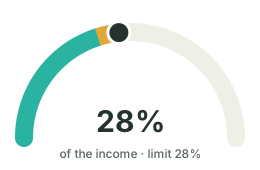
The front ratio: everything you pay for the home each month – principal, interest, property tax, homeowners insurance, HOA dues and PMI – should stay within about 28 % of your gross monthly income.
The back ratio: that housing cost plus all other monthly debts – car loans, student loans, minimum card payments – should stay within about 36 %. Many loan programs allow more, up to around 43 % or higher with strong credit, but each point higher leaves less room in your budget.
What that allows at different incomes
Highest price with $85,000 saved, 6.4% over 30 years, 3 % closing costs, 1.1% property tax, $1,600 insurance a year and PMI where needed – at the 28/36 rule:
| Gross income a month | Highest price | Loan | Housing a month |
|---|---|---|---|
| $6,000 | $282,000 | $205,460 | $1,676.99 |
| $8,000 | $358,000 | $283,740 | $2,236.31 |
| $10,500 | $433,000 | $360,990 | $2,938.67 |
| $13,000 | $523,000 | $453,690 | $3,639.65 |
Test it with a higher rate
Rates can change before you lock one in, and an adjustable rate can rise later. At 8.4% instead of 6.4%, the payment on the same loan would be $2,750.16 – plus tax, insurance and PMI. If that would strain your budget, aim for the comfortable level instead of the limit.
Check your own numbers
Open the affordability tab
In Mortgage Studio, choose “United States ($)” and open “What can I afford?”.
Enter income, debts and savings
Fill in “Monthly gross income (household)”, “Other monthly debts” and “Savings for the purchase”, then the rate and the term.
Pick how tight
Under “How tight?”, compare “Comfortable”, “Typical” and “Lender’s limit”. The gauge shows the share of your income the home takes.
Plan the purchase
“Plan with this price” takes the price into the payment plan, with the full schedule and charts.
Questions you might still have
Is the 28/36 rule a law?
No. It is a common rule of thumb. Loan programs have their own limits, and lenders also weigh your credit, savings and job history.
Do lenders use gross or net income?
In the US, gross income – before tax. That is why the percentages look low: 28 % of gross is a larger share of what you actually take home.
Does a bigger down payment let me buy more?
Yes, twice over: you borrow less for the same price, and below 20 % down you avoid PMI, which also counts against the 28 %.
Sources & useful details
- HCSF – Mesure relative à l’octroi de crédits immobiliers
- CFPB – What is a Qualified Mortgage?
- Banco de España – Portal del Cliente Bancario
- § 489 BGB – Kündigungsrecht des Darlehensnehmers
The screen recordings show LoschaZ tools using sample files created for these guides. They are demonstrations, not tests on every phone or promises of an identical result. Examples are not customer files.