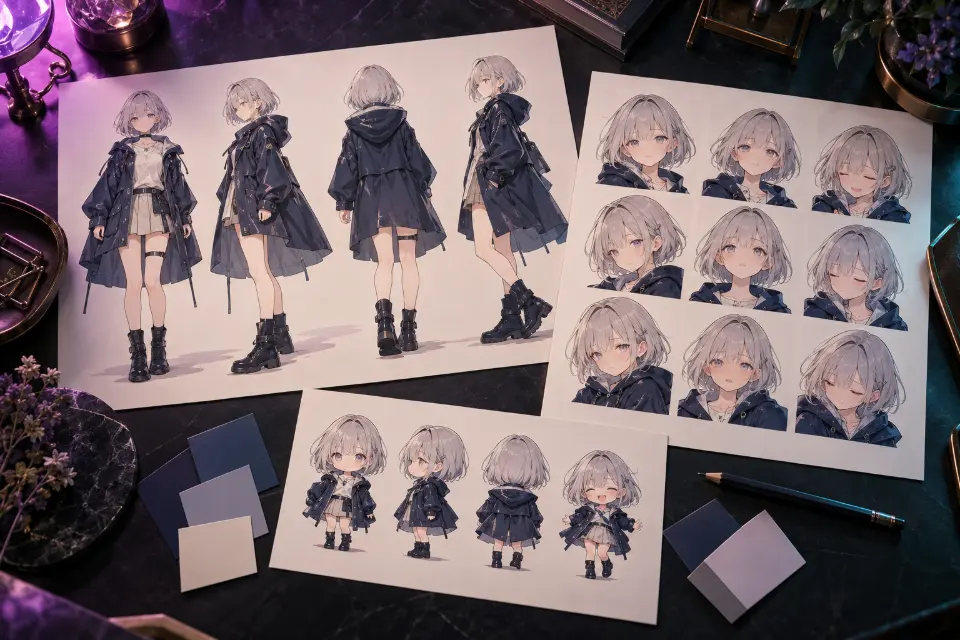
To make an AI anime character that stays yours, write a short character card once – hair, eyes, outfit, one prop, one personality trait and a small color palette – and paste it word for word into every prompt. The model forgets your character between images; the card does not.
The prompts below start with a first design and then turn it into the sheets that artists and game makers rely on: a turnaround from four sides, an expression sheet, outfit variations, a chibi version and a reference card. Every character here is original, and the prompts work in Niji 7, ChatGPT and Gemini.
The short answer
Replace [character description] with your own card, using the same text every time. Start with the design prompt, then the sheets, and upload your favorite design to ChatGPT or Gemini when you need new poses of the same character.
How do I make an AI anime character that stays consistent?
Consistency comes from repetition. The description has to carry everything that must stay the same, so keep it to six short lines like this example and join them into one sentence for the prompt:
For new poses, upload the design you like to ChatGPT or Gemini and say what to keep. A picture holds details better than text alone.
- Hair: short silver bob with one thin braid
- Eyes: amber, a little sleepy
- Outfit: oversized navy raincoat with yellow buttons and rubber boots
- Prop: a battered field notebook
- Personality: curious and slightly clumsy
- Palette: navy, mustard yellow, cream
Which AI anime character generator should you use?
Niji 7 in Midjourney is built for drawn styles and gives polished first designs from text. ChatGPT and Nano Banana in Gemini can take an uploaded design and change only the pose or the outfit, which is what consistency needs. ChatGPT also tends to follow layout instructions such as “nine faces in a three-by-three grid” closely.
Many websites sold as an AI anime character maker run one of these models behind their own buttons, so a clear description matters more than the site. In Prompt Studio you can switch the model and the prompt wording adapts.
What makes a strong anime character design prompt?
Think like a character designer: a clear silhouette, one dominant color and one prop that nobody else in your story carries. Those details survive at small sizes and across many images; a long list of accessories does not.
State the age plainly, such as “in her twenties” or “an adult”, because anime styles can make adults look young. Keep outfits everyday or practical for fantasy work, and show personality through pose and expression rather than adjectives alone.
14 prompts to copy and adapt
First full-body design from your card
Full-body anime character design of an original young woman in her twenties with a short silver bob and one thin braid, sleepy amber eyes, an oversized navy raincoat with yellow buttons, rubber boots and a battered field notebook. Relaxed standing pose, clean line art, soft cel shading, plain warm white background, colors limited to navy, mustard and creamThis is the example card turned into one sentence. Replace it with your own card and keep the part about line art and background for every design.
Turnaround sheet in four views
Character turnaround sheet of [character description], shown in front view, three-quarter view, side view and back view, standing straight with arms slightly away from the body, identical proportions and outfit in every view, evenly spaced on a plain light gray background, clean line art with flat colors, faint horizontal guide lines at head, shoulder and knee heightAvoid: text, labels
The guide lines keep all four views the same height. Use the sheet as a reference for later prompts or for anyone who draws your character.
Expression sheet with nine faces
Expression sheet of [character description]: nine head-and-shoulder drawings in a three-by-three grid showing happy, laughing, surprised, embarrassed, determined, sulking, sleepy, worried and proud. Same hairstyle, eye color and collar in every drawing, clean anime line art, flat colors, plain white background, even spacingAvoid: text, labels
Naming all nine emotions prevents repeats. Pick the ones your story needs, such as nervous or smug, and keep the count at nine for a tidy grid.
Four outfits, one character
Outfit sheet of [character description], drawn four times side by side in the same full-body pose: casual weekend clothes, a winter coat with a knitted scarf, a formal evening outfit and a work uniform for a [job]. Face, hair and proportions stay identical, only the clothes change, flat colors, plain light backgroundSaying that only the clothes change is what keeps the face fixed. Choose outfits that match scenes in your story or game.
Chibi version of your character
Chibi version of [character description]: two heads tall, oversized head, tiny hands and feet, the same hairstyle, eye color and signature prop as the full design, a cheerful pose with one foot kicked up, thick clean outlines, flat bright colors, white background, cute and simpleThe signature prop makes a chibi recognizable at sticker size. Make several poses for emotes or a sticker pack.
New pose from your uploaded design
Use the anime character in my uploaded image as the reference. Keep the face, hairstyle, eye color, outfit, colors and line style exactly the same. Draw the character sitting on a low stone wall, swinging their legs and reading a notebook, seen from a slight high angle, with the same plain background and soft cel shading as the original.Change only the action and the angle each time and leave the keep sentence as it is. That is a dependable way to build a series of poses.
Reference card with color swatches
Character reference card for [character description]: one full-body drawing on the left, a large face close-up on the right, five round color swatches along the bottom for hair, eyes, skin, main outfit color and accent color, small sketches of the signature prop and the shoes, clean layout on cream paperAvoid: text, letters, labels
A card like this is easy to share with an artist or a co-writer. Add names and notes yourself afterward in an editor.
Fantasy village healer
Anime character design of an original fantasy village healer, an adult with dark braided hair wrapped in a green headscarf, a long apron full of pockets with dried herbs, a wooden staff hung with tiny glass bottles, kind tired eyes and a small scar across one eyebrow, full body in three-quarter view, soft cel shading, muted earthy palette, plain parchment backgroundA scar and tired eyes suggest a history without a word of backstory. Swap the healer for a [fantasy job], such as a ferryman or a beekeeper.
Rival with a contrasting design
Anime character design of a rival for [character description]: a tall, composed young man with sharp black hair swept to one side, a crisp white coat with red lining, gloves and a silver pocket watch, arms crossed with a confident half-smile. Colors and shapes that contrast with the hero, full body, clean line art, cel shading, plain gray backgroundRivals work well as opposites: tidy against messy, white against navy. Put the hero’s card in the brackets so the model has something to contrast with.
Mascot for a channel or small shop
Original anime mascot character for a small [shop or channel]: a round, cloud-shaped little spirit with a happy face, tiny arms and a knitted [color] scarf, shown three times in a row – waving, cheering with both arms up and thinking with a hand on its chin. Bold simple shapes that read at icon size, flat colors, white backgroundSimple shapes keep a mascot clear as a tiny avatar. Use the scarf color from your logo so it fits the rest of your page.
Small robot sidekick
Anime design of a small companion robot for [character description]: a round body the size of a cat, one big glowing eye, stubby legs, an antenna with a little bell and scuffed paint in the hero’s colors, shown from the front and from the side, flat colors, clean outlines, white backgroundReusing the hero’s palette makes a sidekick look like it belongs. Change the robot to a [small animal] for a fantasy story.
Dynamic action pose: a sliding stop
[character description] in a dynamic action pose, sliding to a stop on one knee across wet pavement after a sprint, coat flaring behind, rain splashing up in an arc, looking up with a determined expression, low camera angle, dramatic rim light from a streetlamp, crisp line art and bold cel shadingA pose that freezes the end of a movement tells the viewer what just happened. Keep the card first so the action does not replace the design.
Key visual for a cast of three
Key visual for an original anime story: three original characters standing together on a grassy ridge under a vast starry sky, [character 1], [character 2] and [character 3], each in a pose that shows their personality, clear silhouettes, contrasting color schemes, crisp line art, cinematic composition with open sky above them for a title added laterAvoid: text, letters, logo
Three characters is a sensible limit for one picture. Keep each card short here, or the characters start to swap details.
The same character ten years later
Use the anime character in my uploaded image. Keep the face shape, eye color, signature prop and art style the same. Draw the character ten years older: slightly longer hair, a calmer expression, a more practical version of the outfit and a few small signs of the years in between, in the same full-body pose and plain background.Time skips are a classic story beat. Keeping the prop and the eye color fixed makes the older version read as the same person.
Anime OC ideas: where to start
An original character, or OC, grows from a situation more easily than from a look. Start with a job, a place and a small wish, then let the design follow. A few starters to adapt:
- A lighthouse keeper who collects umbrellas left behind on the night ferry.
- A night-market cook who wants to win a noodle contest.
- A retired adventurer who now repairs bicycles.
- A museum guard who sketches the paintings after closing time.
- A beekeeper who talks to her bees and is sure they answer.
Common character design mistakes and quick fixes
Change one thing at a time and keep the rest of the prompt the same.
- The outfit changes between images: paste the full card again and upload the last good design.
- Extra fingers or odd hands: ask to fix only the hands in a follow-up.
- Fake labels on a sheet: add text and labels to the avoid list.
- A generic face: add one distinct detail, such as freckles, a mole or round glasses.
- An adult looks too young: write the age into the card.
Can I use these characters in my own comic or game?
The prompts are free to copy, and the character you describe is your own idea. Whether you may use the images commercially depends on the terms of the generator you used, so read them before you print merchandise or sell a game.
If a result looks very close to an existing character, change the hair, colors and outfit until it doesn’t. That is safer, and it makes the design more clearly yours.
Which character sheet do you need?
| Sheet | What it shows | Use it for | Format |
|---|---|---|---|
| Turnaround | Front, three-quarter, side and back | Consistent poses, 3D models, cosplay | 16:9 |
| Expression sheet | Nine faces with different emotions | Comics, visual novels, stickers | 1:1 |
| Outfit sheet | Four outfits on one body | Seasons, story chapters, game skins | 16:9 |
| Chibi version | A cute version two heads tall | Emotes, sticker packs, merch mockups | 1:1 |
| Reference card | Full body, face and color swatches | Briefing an artist or co-writer | 3:2 |
Questions and answers
How do I make an AI anime character from scratch?
Write a six-line card with hair, eyes, outfit, prop, personality and palette, turn it into one sentence and use the first design prompt on this page. Generate a few versions and keep the one that fits your idea.
Is there a free AI anime character generator?
Prompt Studio is free and writes the prompts without an account. The image generators have their own plans: ChatGPT and Gemini have offered a limited number of free images, while Midjourney with Niji 7 needs a paid plan.
Can an AI anime character maker keep the same character?
Mostly, if you repeat the same description word for word and upload your favorite design as a reference for new poses. Small details still drift, so check hair, eyes and props and fix them in a follow-up.
How do I make an AI anime character sheet?
Use the turnaround, expression or outfit prompt above with your character card in the brackets, and add text and labels to the avoid list so the sheet stays clean.
Can I turn my photo into an anime character?
Yes, with an edit prompt that keeps your hairstyle and face shape recognizable. The photo to anime collection has prompts for that; use other people’s photos only with their permission.
Why do the prompts avoid famous characters?
Images of existing characters belong to their creators, and many apps block them. An original design is also more useful, because you can reuse it in a manga, a profile picture or a short clip.