

The short answer
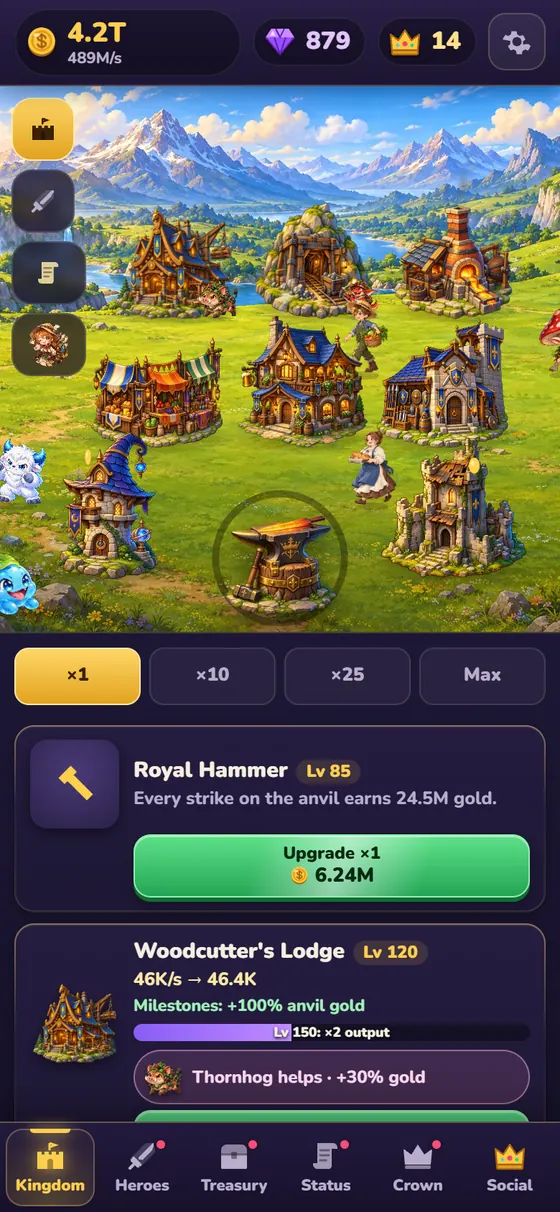
An idle clicker game pays you for clicking at first, then lets you buy things that earn on their own. In Lumivale you tap the royal anvil for gold, build the lumber hut for 15 gold and recruit Sir Brannoc for 40. After that, buildings produce gold and heroes fight through the stages by themselves. Your job is to decide where the next gold goes: buildings for income, hero levels for damage, gear for both. When a boss stops you, push a few hero milestones or start a new age from stage 40.
Play free in your browserWhat is an idle clicker game?
An idle clicker game is built from two phases that overlap. In the clicker phase, every tap or click gives you a resource. In the idle phase, you spend that resource on producers that keep earning without input, and those producers buy more producers. The game is about deciding what to buy next, not about how fast you can click.
Lumivale follows that pattern with a fantasy coat. The royal anvil is the click: each strike forges gold and heats the forge, and a full heat bar turns the next strike into a masterwork with a large payout. The eight buildings are the automation. The party of heroes is the part that moves the story along: they attack the current monster on their own and carry you through eight regions, ten stages each, with a timed boss on every tenth stage.
This also explains why idle games feel different from action games. A good minute is one where you made a sensible choice, not one where you pressed many buttons.
Clicker game vs idle game: what is the difference?
People often use the two words for the same thing, but they describe different moments of play. A pure clicker rewards activity. A pure idle game rewards patience and planning. Most games, Lumivale included, mix both and shift the weight over time.
| Moment | What you do | What it looks like in Lumivale |
|---|---|---|
| First minutes | Click for every coin | Tap the anvil, build the lumber hut, recruit Sir Brannoc |
| Early game | Buy your first producers | Buildings and hero levels; tapping still matters |
| Mid game | Plan upgrades, push walls | Hero milestones, gear, the first boss walls |
| Long game | Reset for permanent bonuses | A new age from stage 40, crowns and royal decrees |
Your first ten minutes in Lumivale
The opening goes quickly once you know the order. These steps match what the game shows you.
Tap the anvil
Strike the royal anvil until you have 15 gold. With a keyboard, the Space bar strikes too.
Build the lumber hut
Your first building earns on its own from the moment it stands. Add levels whenever the price fits.
Recruit Sir Brannoc
At 40 gold the knight joins and starts fighting. Every hero after him costs more and hits harder.
Aim for milestones
Heroes double their damage at levels 10, 25, 50, 75 and 100, then every 25 levels. Buildings double their output at their own milestones.
Open the first chest
Chests fill three gear slots per hero. Better pieces are equipped automatically unless you turn that off.
How do heroes get stronger? Milestones, gear and stars
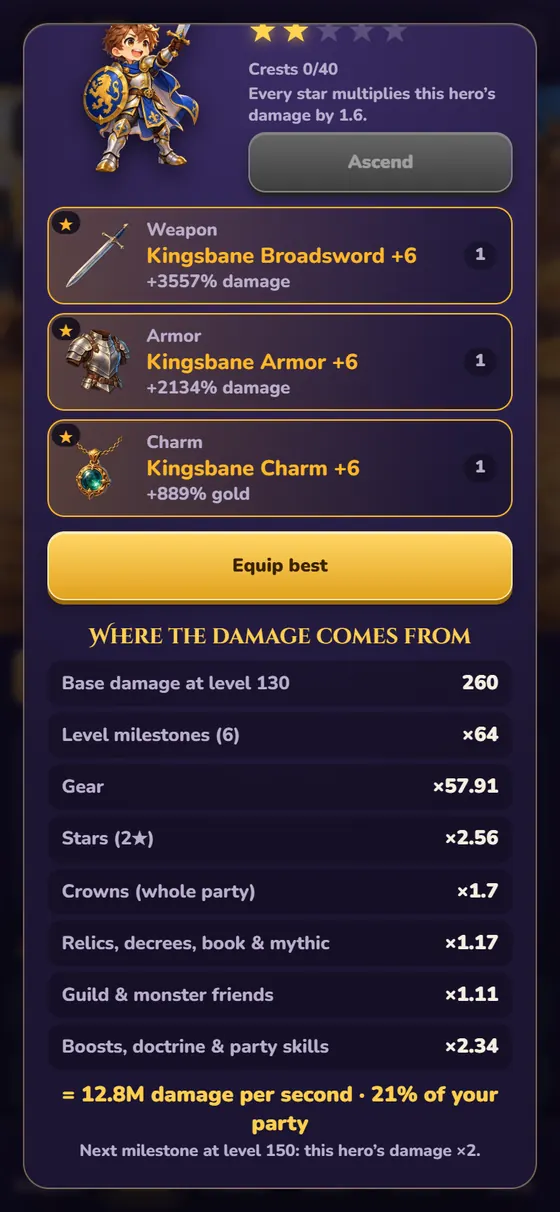
Hero damage is a chain of multipliers, and the hero window shows every link of it: the base value for the current level, the milestones reached, gear, stars and any skill that is active right now, then the bonuses for the whole party from crowns, relics, guild and monster friends. If a number looks small, that window tells you which link to work on.
Gear comes in six rarities. Each one has its own colour and its own shape (● ▲ ■ ◆ ★ ✦), so you can tell them apart even without colour. Spare pieces can be melted into essence, which the forge uses to raise a piece up to +10, or fused three to one into the next rarity. Stars come from crests found in chests: five stars, each multiplying that hero’s damage by 1.6.
Stuck at a boss? When to start a new age
Every tenth stage is a boss with a timer. If the timer runs out, the party drops back one stage, keeps everything it earned and keeps fighting there. Use the time to level a hero to its next milestone, then press Challenge boss.
Idle games with prestige ask you to restart on purpose, and Lumivale does that with a new age. From stage 40 the Crown tab shows how many crowns a restart would pay. Buildings, heroes, gold and stages begin again; gems, chests, gear, relics, the monster book and your crowns stay. Every crown you have ever earned adds 5 percent gold and damage for good, and crowns also buy seven royal decrees. A practical rule: when progress slows to a crawl and the crown count would clearly grow, take the new age. The next run reaches the old wall much faster.
Do idle games play themselves? What happens while you are away
Partly. In Lumivale the buildings keep earning while the tab is closed, and a welcome-back window shows the gold when you return: up to two hours at first, up to 16 hours as the keep grows. The heroes do not fight while you are away; progress through the stages happens while the game is open.
Your kingdom saves in the browser you play in. Idle games that save your progress can still lose it when site data is cleared, so Lumivale has two ways to keep it safe: a transfer code in Settings, valid for 24 hours and usable once, and a backup file you can store yourself. Both show what the save contains before anything is replaced.
Monster book, helpers and weekly events
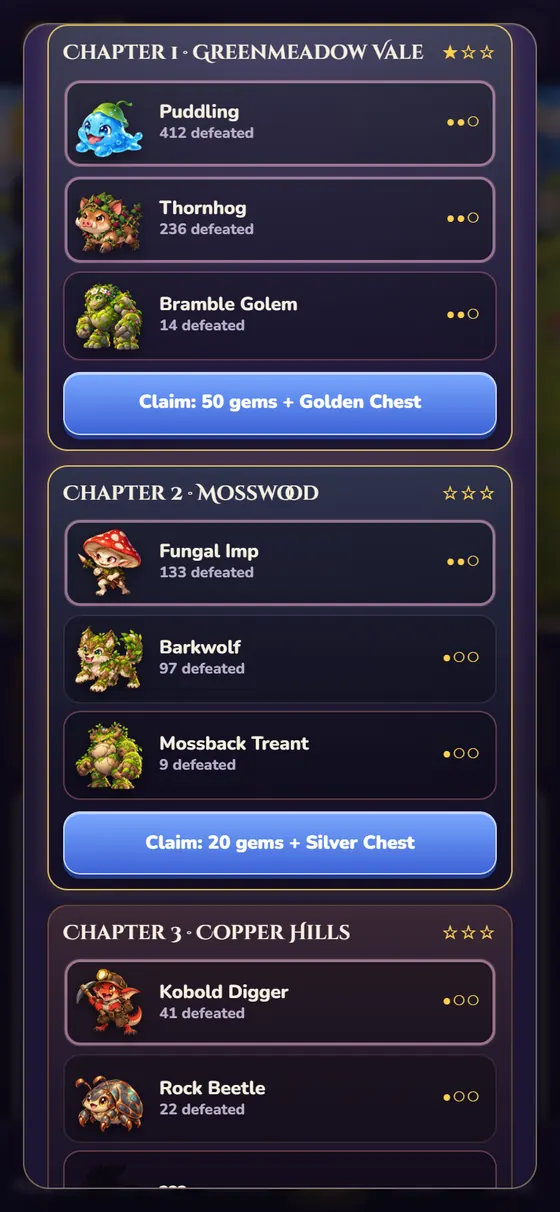
Every defeated monster fills a page in the monster book. A region is a chapter with its two monsters and its boss; pages reach marks at 10, 100 and 1,000 defeats, boss pages at 1, 10 and 50. A closed chapter mark pays gems and a chest and adds one percent damage for good. Some monsters become friends along the way. A friend can help in one building for 15 percent more gold there, a boss friend for 30, and each monster has a favourite building where the bonus doubles.
Each week brings one themed event, for example a boss week with double boss gems or a forge week with cheaper forging. The Status tab shows the current one, how long it lasts and which week comes next.
Can you play idle games with friends? Guilds in Lumivale
Yes, in a relaxed way. Pick a champion name to appear on seven leaderboards, then found a guild for 150 gems or join an open one. Members build the guild with one donation of each kind per day; each guild level adds seats (30 at the start, five more per level) and a small gold and damage bonus for everyone. Once a week the guild shares a boss: every member has three attacks per day, and when it falls, everyone who helped claims a royal chest and 50 gems.
Guilds also have their own chat for short filtered messages, while the world chat uses only set phrases and stickers. Any line can be muted on your device or reported. There is no direct co-op battle; the multiplayer part of this idle game is cooperation over days, not live play.
Questions you might still have
What are idle games?
Idle games are games where progress continues with little or no input. You make the decisions, the game repeats the work. In Lumivale buildings earn gold and heroes fight on their own.
Is Lumivale a free browser RPG game?
Yes. It runs in your browser on its game page, with no download, no account and no purchases. It works on phones and computers.
Is Lumivale pay to win?
No. There is nothing to buy. Gems come from bosses, records, daily gifts, hidden glimmers, the monster book and guild rewards.
Is Lumivale one of the anime idle games?
Its art is an original anime style by LoschaZ Games: chibi heroes on the battlefield and anime portraits in the story scenes. It is not based on any anime series.
What happens after the last region?
After the Shadow Citadel the regions return as star rounds: stronger monsters, more gems and no final level. Your highest stage counts on the leaderboard.
Should I keep clicking once the kingdom earns on its own?
Clicking always helps a little because part of each strike scales with your income. Most of your growth later comes from buildings, hero milestones and new ages.
Sources & useful details
These guides are written from the current LoschaZ tools and the sources listed above. Examples are illustrations, not tests on every device or promises of an identical result.