The short answer
The Carolina wolf spider, the largest wolf spider in North America, measures 3 to 4 in (7.6 to 10.2 cm) with its legs, according to South Carolina State Parks. Its body alone is about 1 in (2.5 cm), says the South Carolina Encyclopedia. With legs spread it is about as long as a credit card (3.37 in / 85.6 mm), three to four times the span of a brown recluse and about a third of the largest Goliath birdeater’s.
Open the free toolHow big is a wolf spider? Body length and leg span
The biggest wolf spiders in North America are 3 to 4 in (7.6 to 10.2 cm) across, legs included. That figure belongs to the Carolina wolf spider, which South Carolina State Parks calls the largest wolf spider in North America and which South Carolina named its official state spider in 2000.
The body is much smaller. The South Carolina Encyclopedia says an adult male reaches nearly 1 in (2.5 cm) in body length and a female 1 in or more. So when one source says one inch and another says four, they often describe the same spider, measured without and with its legs.
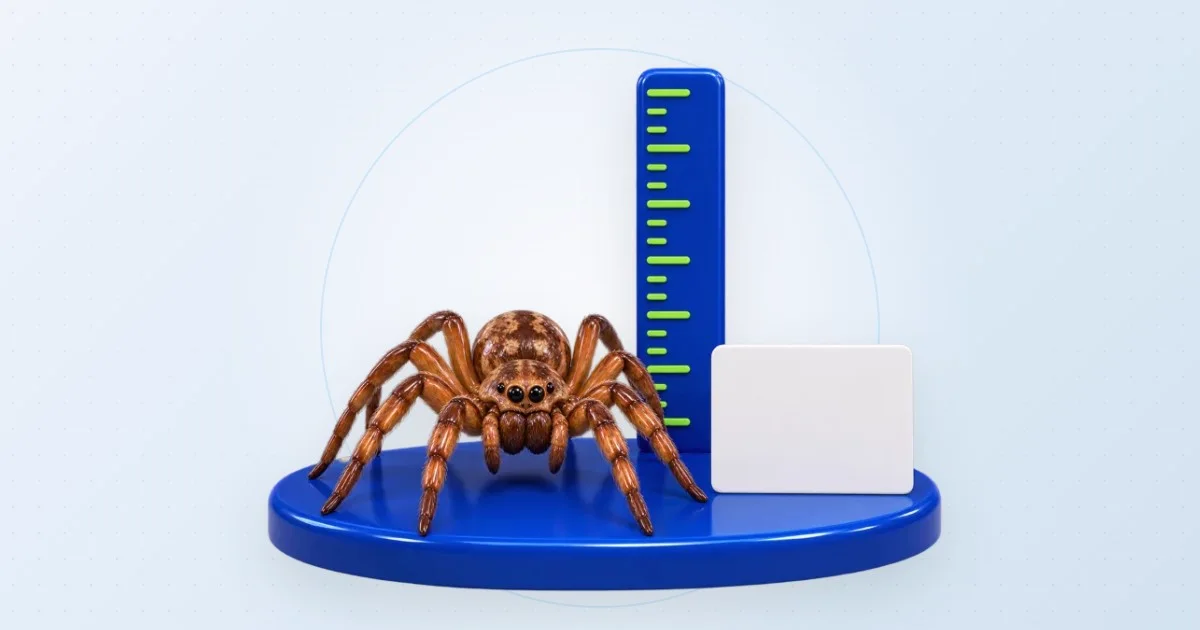
Because the Carolina wolf spider is the largest, the wolf spider in your garage may be well under these numbers. Height Studio draws it at 3.5 in (8.9 cm) leg span, the middle of the 3 to 4 in range, and measures every spider across its spread legs.
Wolf spider size comparison to a credit card and a coin
With its legs spread, a large Carolina wolf spider is about as long as a credit card. A standard bank card is 3.37 in (85.6 mm) on its long side under ISO/IEC 7810, against the spider’s 3.5 in (8.9 cm) in Height Studio.
A US quarter, 0.955 in (24.26 mm) across according to the US Mint, fits about three and a half times across that leg span. The body alone, at about 1 in, is roughly the width of the quarter.
Both objects have fixed, standardized sizes, which is why they work as a scale in photos. A card or coin next to a picture of a spider shows the size better than a description.
Wolf spider vs huntsman, tarantula and banana spider
Next to the world’s giant spiders, the wolf spider is mid-sized. The Natural History Museum in London gives males of the giant huntsman spider from Laos a leg span of around 30 cm (11.8 in), the length of a standard ruler. San Diego Zoo Wildlife Alliance gives 11 in (28 cm) for the largest tarantula leg span, a male Goliath bird-eating spider; that is a maximum, not a typical size.
Closer to home, mature female golden silk orb-weavers, often called banana spiders, have leg spans of 3 to 4 in (7.6 to 10.2 cm), the same range as the Carolina wolf spider, according to Mississippi State University Extension. The same goes for female Joro spiders, which the University of Georgia Extension describes as four times larger than the males.

Wolf spider vs brown recluse, black widow and jumping spider
Several well-known house and garden spiders are much smaller than a big wolf spider:

- Brown recluse: with legs extended, about the size of a US quarter (0.955 in / 24.26 mm), according to University of Kentucky Entomology.
- Black widow: adult females have a body of about 1/2 in (1.25 cm) and a leg span of about 1 1/2 in (4 cm), according to Virginia Cooperative Extension.
- Daddy long-legs or cellar spider: up to 45 mm (1.8 in) overall, according to the Natural History Museum in London.
- Zebra jumping spider: about 8 mm (0.3 in) overall, legs included, according to the same museum.
Wolf spider or brown recluse? Size and other clues
Size is a weak clue on its own, but it helps: an adult brown recluse with legs extended is about the size of a quarter, while a large wolf spider spans several inches. The eyes are a better sign. CDC’s NIOSH page on venomous spiders says the brown recluse has six equal-sized eyes, while most spiders have eight, and a dark violin-shaped marking on its head. South Carolina State Parks describes the Carolina wolf spider’s eight eyes in three rows: four small ones at the bottom, two very large ones in the middle and two medium-sized ones on top.
Wolf spider mothers are easy to recognize too. South Carolina State Parks explains that females carry their eggs in a round silk sac attached to the abdomen, and that the young climb onto their mother’s back after hatching.
Make your own spider size comparison
Open the spider size comparison
It opens with a credit card next to spiders from the zebra jumping spider up to the giant huntsman, all measured across the legs.
Add or remove spiders
Use “Search the library” to add, for example, the Brazilian wandering spider, or remove figures in “Line-up”.
Frame the small ones
A jumping spider looks tiny next to a huntsman. Use the zoom buttons or “Fit all” to frame the figures you care about.
Share
Use “Share link” or “Save PNG”. Nothing you enter leaves your device.
Questions you might still have
How big do wolf spiders get?
The largest North American species, the Carolina wolf spider, measures 3 to 4 in (7.6 to 10.2 cm) with its legs and about 1 in (2.5 cm) in body length. Many wolf spiders are smaller.
How big is a wolf spider with legs?
A large Carolina wolf spider spans 3 to 4 in (7.6 to 10.2 cm) with its legs spread, about the length of a credit card (3.37 in / 85.6 mm).
Is a wolf spider bigger than a brown recluse?
A large wolf spider is much bigger. An adult brown recluse with legs extended is about the size of a US quarter (0.955 in / 24.26 mm), roughly a quarter to a third of a big wolf spider’s span.
Is a wolf spider bigger than a tarantula?
Not than the big ones. The largest Goliath birdeater spans 11 in (28 cm), according to San Diego Zoo Wildlife Alliance, about three times a large wolf spider.
How can I tell a wolf spider from a brown recluse?
Look at the eyes: CDC says the brown recluse has six equal-sized eyes and a dark violin-shaped mark on its head. The Carolina wolf spider has eight eyes in three rows, two of them very large.
Are wolf spiders dangerous?
This guide makes no health claims about wolf spiders. CDC’s NIOSH page names the black widow and the brown recluse as the venomous spiders in the United States and does not list wolf spiders. After any spider bite, follow CDC’s first-aid steps and get medical care.
Sources & useful details
- South Carolina State Parks: Carolina wolf spider
- South Carolina Encyclopedia: Carolina wolf spider
- ISO/IEC 7810 ID-1 card size (abstract via EVS)
- United States Mint: Coin specifications
- Natural History Museum, London: The world’s most extreme spiders
- San Diego Zoo Wildlife Alliance: Tarantula
- Mississippi State University Extension: Golden silk spider or Joro spider?
- University of Georgia Extension: Here to stay, Joro spiders
- University of Kentucky Entomology: Brown recluse spider (ENTFACT-631)
- Virginia Cooperative Extension: Widow spiders (444-422)
- Natural History Museum, London: Daddy long legs spider
- Natural History Museum, London: Zebra jumping spider
- CDC/NIOSH: Venomous spiders at work
- LoschaZ Height Studio: spider size comparison
- LoschaZ guide: how big is a blue whale?
- LoschaZ guide: megalodon shark size comparison
- LoschaZ guide: Titanic size comparison
- LoschaZ guide: polar bear size comparison
- LoschaZ guide: Maine Coon cat size comparison
- LoschaZ guide: Earth, Moon and Sun size comparison
These guides are written from the current LoschaZ tools and the sources listed above. Examples are illustrations, not tests on every device or promises of an identical result.