The short answer
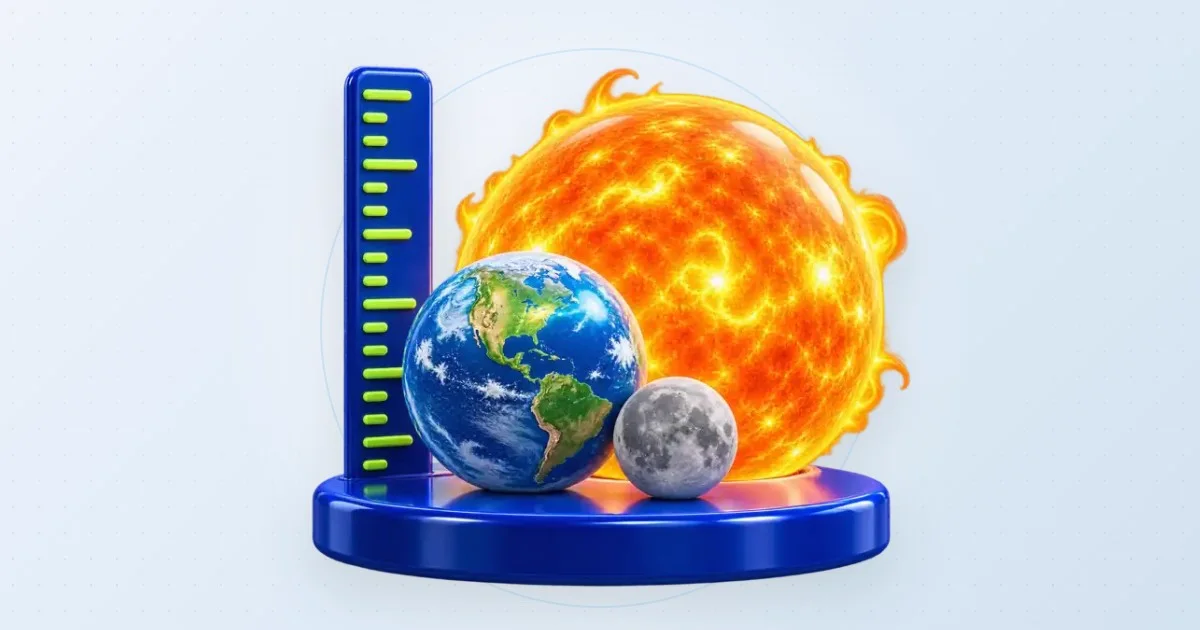
Earth is 7,926 miles (12,756 km) across and the Moon 2,159 miles (3,475 km), so the Moon is about 27 percent as wide as Earth, and about 50 Moons would fill Earth’s volume. The Sun is about 864,600 miles (1,391,400 km) across: 109 Earths side by side, or nearly 10 Jupiters. By volume, about 1.3 million Earths would fit inside it.
Open the free toolEarth to Moon size comparison: how big is the Moon?
The Moon is about 27 percent as wide as Earth. NASA’s Planetary Fact Sheet gives Earth’s equatorial diameter as 7,926 miles (12,756 km) and the Moon’s diameter as 2,159 miles (3,475 km). That means 3.7 Moons would fit side by side across Earth.
By volume the gap is much bigger, because volume grows with the cube of the diameter: 3.67 × 3.67 × 3.67 is about 49.5, so roughly 50 Moons would fill the space of one Earth. Neither body is a perfect sphere, so treat that as a rounded count.
A model you can hold makes it easier. If Earth were a size 7 basketball, 9.5 in (24.2 cm) across under FIBA’s rules, the Moon would be about 2.6 in (6.6 cm) wide, almost exactly a tennis ball, which the ITF sets at 2.57 to 2.70 in (6.54 to 6.86 cm).

Mars Earth size comparison, plus Mercury, Pluto and the big moons
Mars is just over half as wide as Earth: 4,220 miles (6,792 km) against 7,926 miles (12,756 km), or 53 percent. By volume that is about 15 percent of Earth, so six and a half Mars would fill one Earth. Mars is also almost exactly twice as wide as the Moon (1.95 times). In the basketball model, Mars would be about 5.1 in (12.9 cm) across.
Mercury, 3,032 miles (4,879 km) wide, sits between the Moon and Mars. Two moons are bigger than Mercury: Jupiter’s Ganymede, the largest moon in the solar system at 3,270 miles (5,262 km), and Saturn’s Titan at 3,200 miles (5,150 km), both from NASA’s satellite fact sheets.
Pluto is smaller than our Moon. NASA gives its equatorial diameter as about 1,477 miles (2,377 km), roughly two thirds of the Moon’s width.
Earth sun size comparison: how many Earths fit in the Sun?
About 109 Earths fit across the Sun, and about 1.3 million inside it. NASA’s Sun Fact Sheet gives a volumetric mean radius of 695,700 km (about 432,300 miles), so the Sun is about 864,600 miles (1,391,400 km) across, 109 times Earth’s diameter.
The volume count follows from the cube: 109 × 109 × 109 is about 1.3 million. That is a count by volume; real Earth-sized balls packed into the Sun would leave gaps between them.
In the basketball model, the Sun would be a ball about 87 ft (26.4 m) across, a little shorter than a 92 ft (28 m) FIBA basketball court and roughly as long as a typical blue whale. The Sun is also about 400 times as wide as the Moon. Both look about the same size in our sky only because the Sun is so much farther away.

Jupiter sun size comparison
The Sun is nearly 10 times as wide as Jupiter, and Jupiter about 11 times as wide as Earth. NASA gives Jupiter an equatorial diameter of 88,846 miles (142,984 km), measured at the level where the atmospheric pressure is 1 bar, since the planet has no solid surface to measure. So 9.7 Jupiters span the Sun, and 11.2 Earths span Jupiter.
In the basketball model, Jupiter would be about 8 ft 11 in (2.7 m) across, more than 2 ft taller than a standard 6 ft 8 in (2.03 m) US door, while the Sun would be the 87 ft ball from above. Jupiter is the largest planet, yet it is a small body next to its star.
Solar system size comparison chart: planets and the Sun
Equatorial diameters from NASA’s fact sheets, largest first, with the ratio to Earth. The Sun’s value is twice its mean radius, Ganymede’s twice its mean radius:
| Body | Diameter | × Earth |
|---|---|---|
| Sun | 864,576 mi (1,391,400 km) | 109.1 |
| Jupiter | 88,846 mi (142,984 km) | 11.21 |
| Saturn, without rings | 74,898 mi (120,536 km) | 9.45 |
| Uranus | 31,763 mi (51,118 km) | 4.01 |
| Neptune | 30,775 mi (49,528 km) | 3.88 |
| Earth | 7,926 mi (12,756 km) | 1.00 |
| Venus | 7,521 mi (12,104 km) | 0.95 |
| Mars | 4,220 mi (6,792 km) | 0.53 |
| Ganymede, moon of Jupiter | 3,270 mi (5,262 km) | 0.41 |
| Mercury | 3,032 mi (4,879 km) | 0.38 |
| Moon | 2,159 mi (3,475 km) | 0.27 |
| Pluto, dwarf planet | 1,477 mi (2,377 km) | 0.19 |
Make your own planet size comparison
Open the planet size comparison
It opens with the planets from Mercury to Jupiter next to the Sun, all at the same scale.
Switch the line-up
Under “Ideas to try”, pick “Moons & dwarf planets” for the Moon, Pluto and Ganymede, or “Stars” to see the Sun next to bigger stars.
Make the small ones visible
Earth and the Moon are tiny next to the Sun. Remove the Sun in “Line-up” or use the zoom buttons to see them properly.
Choose units and share
Under “Units”, “ft / in” shows miles and “cm / m” shows kilometers. Tap a body to compare it with the others, then use “Share link” or “Save PNG”.
Questions you might still have
How big is the Moon compared to Earth?
About 27 percent as wide: 2,159 miles (3,475 km) against 7,926 miles (12,756 km), according to NASA. Roughly 50 Moons would fit into Earth’s volume.
How many Earths can fit in the Sun?
About 109 side by side across the Sun’s diameter, and about 1.3 million by volume, computed from NASA’s diameters. Packed as real balls, fewer would fit because of the gaps.
How big is Mars compared to Earth?
Mars is 4,220 miles (6,792 km) across, about 53 percent of Earth’s width and about 15 percent of its volume. It is roughly twice as wide as the Moon.
How big is Jupiter compared to the Sun?
The Sun is about 9.7 times as wide as Jupiter: 864,576 miles (1,391,400 km) against 88,846 miles (142,984 km). Jupiter itself is about 11 times as wide as Earth.
Why do the Sun and Moon look the same size?
The Sun is about 400 times as wide as the Moon, but it is also much farther away, so both discs cover about the same patch of our sky. Height Studio compares real sizes, not how big things look from Earth.
Is the Sun a big star?
It is in the middle among the stars in Height Studio. Proxima Centauri, the nearest star to the Sun, has about 0.141 times the Sun’s radius (NASA Exoplanet Archive). Sirius A has 1.713 times the Sun’s radius in a study by Davis and colleagues, and the red supergiant Betelgeuse is estimated at about 764 solar radii, an uncertain value because the star pulsates. NASA notes that Betelgeuse at the center of our solar system would reach past the orbit of Jupiter.
Sources & useful details
- NASA Goddard Space Flight Center (NSSDC): Planetary Fact Sheet, metric
- NASA Goddard Space Flight Center (NSSDC): Sun Fact Sheet
- NASA Goddard Space Flight Center (NSSDC): Jovian Satellite Fact Sheet
- NASA Goddard Space Flight Center (NSSDC): Saturnian Satellite Fact Sheet
- NASA Science: Pluto facts
- FIBA: Official Basketball Rules 2026, Basketball Equipment (ball size 7)
- ITF: Rules of Tennis 2026, Appendix I The Ball
- FIBA: Official Basketball Rules 2026 (court size)
- Animal Diversity Web: Balaenoptera musculus (blue whale)
- Davis et al., PASA: The angular diameter and fundamental parameters of Sirius A
- Joyce et al., The Astrophysical Journal: new mass and distance estimates for Betelgeuse
- NASA Science: Hubble sees red supergiant star Betelgeuse slowly recovering after blowing its top
- NASA Exoplanet Archive: Proxima Centauri stellar radius
- Masonite: door specifications by height (6′8″, 7′0″, 8′0″)
- LoschaZ Height Studio: planet size comparison
- LoschaZ guide: how big is a blue whale?
- LoschaZ guide: megalodon shark size comparison
- LoschaZ guide: Titanic size comparison
- LoschaZ guide: polar bear size comparison
- LoschaZ guide: wolf spider size comparison
- LoschaZ guide: Maine Coon cat size comparison
These guides are written from the current LoschaZ tools and the sources listed above. Examples are illustrations, not tests on every device or promises of an identical result.